
Test Benches & Load Banks
Custom test facilities and load banks for motors, generators, inverters and drivetrains
A custom test facility service that designs, builds and automates test benches and load banks for motors, alternators, generators, inverters, turbines and EV components, for manufacturers, research labs and power equipment users.
Last updated:
What the system does
Testing a motor, alternator or inverter needs a rig built around the product: the right load, drives, instrumentation, safety interlocks and data capture. Off-the-shelf benches rarely fit.
We design and manufacture customised test beds, from mechanical and electrical design to control panels, PLC and SCADA automation and test data reporting. Our own R&D and test facility supports testing up to 1 MW.
Facilities we have delivered include a 1,000 kW motor test bed, a 3 MW inverter test facility, a 2 MW turbine test facility, a 33 kV wind LVRT test facility and an EV component test facility at 1.5 kV.
- 01
Rotating machine test beds
Test facilities for motors, alternators, generators, traction motors, engines and high-speed rotors.
- 02
Power electronics testing
Inverter and PSU test facilities, including wind inverter efficiency testing and power supplies for defence applications.
- 03
Grid and wind testing
Wind LVRT test facilities, including a mobile 10-36 kV WEC LVRT lab.
- 04
Environmental and vibration testing
Environmental chambers, electro-dynamic vibration testing and vibration measurement for locomotive products.
- 05
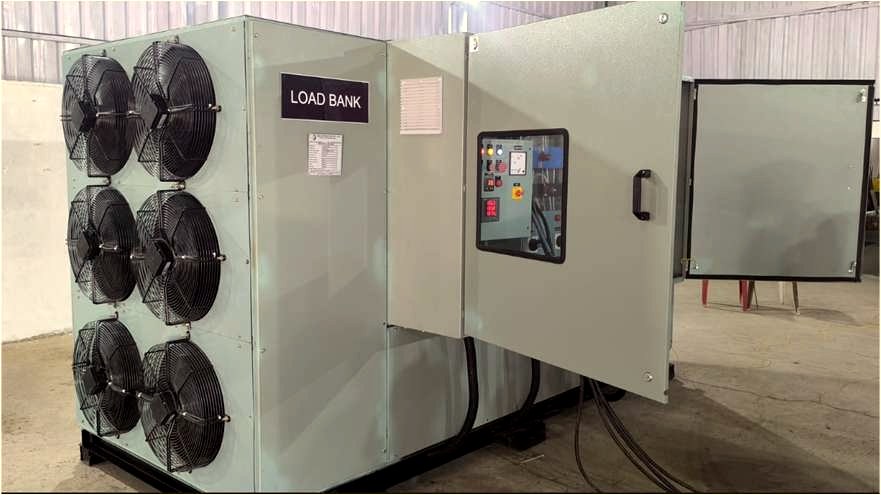
Load banks
Load banks for generator and power system testing, built in our panel manufacturing units.
- 06
Automation and data capture
PLC and SCADA control of the test sequence, with interlocks, data logging and test reports.
- 07
Long-duration reliability testing
Endurance test setups such as alternator reliability testing over a 2-month test cycle.
Across the automation layers
What the solution does at each layer of your facility.
L1 · Field
Installs drives, load machines, sensors and instrumentation on the device under test.
L2 · Control
Provides PLC-based control panels, drive panels and safety interlocks for the test sequence.
L3 · Supervision
Runs SCADA and HMI screens for test setup, live values, alarms and data logging.
L4 · Enterprise
Generates test reports and keeps test data for product quality and certification records.
Scope and specification
| Facility | Rating / scope |
|---|---|
| Motor test bed | 1,000 kW |
| Inverter test facility | 3 MW |
| Turbine test facility | 2 MW |
| Rotating machine test setup | 1 MW |
| Generator test facility | 560 kW |
| Engine test | 500 kW |
| Alternator testing | 500 kVA; reliability test over a 2-month cycle |
| Wind LVRT test facility | 33 kV; mobile 10-36 kV WEC LVRT lab |
| EV component test facility | 1.5 kV |
| Vibration test | 12 T electro-dynamic vibration test |
What it means for operations
Sectors served
- A rig built for your productLoads, drives and instrumentation match the ratings and test standards you need.
- Repeatable testsAutomated sequences and interlocks run each test the same way every time.
- Test records on handLogged data and generated reports support quality and certification records.
Frequently asked questions
Can you build a test bench to our test standard?
Yes. Each test facility is designed from your test specification, covering the load, drives, measurement and safety requirements. We confirm the scope in the requirement study before design.
What ratings have you built for?
Delivered facilities range from component and PSU testing up to a 3 MW inverter test facility, a 2 MW turbine test facility and a 33 kV wind LVRT test facility.
Do you supply load banks separately?
Yes. Load banks are part of our panel manufacturing range and can be supplied on their own or as part of a test facility.
Who are typical users of these facilities?
Our test facilities serve rotating machine and power electronics manufacturers, defence and research laboratories, shipbuilders and wind and solar equipment makers.
Let’s start by understanding your facility
Send us a short description of the site and its current systems, and an engineer will come back with clear next steps.